04.02.2026

Pollybell Farm and Flogas announce strategic partnership to deliver a low-carbon alternative to LPG

Pollybell Farms and Flogas Britain have announced a strategic partnership to address one of the UK’s most pressing decarbonisation challenges: how to provide low-carbon, high heat energy for the two million households and businesses that rely on off-grid LPG.
The collaboration brings together Pollybell’s expertise in sustainable farming and integrated land-use systems with Flogas Britain’s long-standing role as a leading supplier of LPG and future low-carbon fuels. Together, the partners will explore the production and distribution of renewable dimethyl ether (rDME), a replacement for fossil LPG.
The partnership is being advanced through RePeat, a £2.4 million research and development project led by Pollybell Farm in collaboration with Flogas Britain and the University of Lincoln. RePeat has secured funding from Defra’s Farming Innovation Programme, delivered in partnership with Innovate UK, to investigate a new circular farming and fuel model that integrates food production, renewable energy and land-use change at the farm scale.
Based across Pollybell’s 5,000 acres of organic farmland covering Lincolnshire, Nottinghamshire and South Yorkshire, RePeat builds on the farm’s long-standing commitment to the environment and innovation. The project brings together proven technologies and examines how English farmers can remain productive while responding to climate pressures, volatile markets and the transition to a low-carbon economy.
At the heart of RePeat is the development of an on farm rDME production facility. Using farm-grown biomass as a feedstock, the project will explore how renewable fuel production can sit alongside commercial farming, while co-products such as heat and captured CO₂ are reused to support year-round food production. The approach is designed to demonstrate how agriculture can play a direct role in supplying low-carbon fuels for rural and off-grid energy users.
The concept for RePeat has emerged from several years of research into rethinking land management and on-farm energy systems. Pollybell has previously delivered major R&D projects examining peatland management, controlled environment agriculture (CEA) and biomass processing, identifying opportunities to link these elements into a single, integrated system that produces food and green fuel sustainably with environmental benefits.
For Flogas Britain, the partnership reflects a strategic focus on developing practical, scalable decarbonisation pathways for customers who depend on high-heat energy. Renewable DME offers a compelling solution, enabling significant carbon reductions.
The provenance of rDME through the RePeat system creates opportunity to produce a significantly negative carbon intensity fuel. This rDME can then be blended with LPG to create a low carbon fuel which is a drop-in replacement for fossil LPG and can be used within existing domestic and commercial infrastructure without the need for disruptive changes to appliances.

Geoff Mullett, Business Development Manager – Fuels, Flogas Britain, said:

“This partnership with Pollybell is about starting from real-world challenges and solving them collaboratively. RePeat allows us to explore how renewable, farm-derived fuels like rDME could provide a credible, low-carbon alternative to LPG for rural homes and businesses. It’s a practical approach, grounded in working farms and existing energy systems.”
The University of Lincoln brings independent scientific expertise to the consortium, providing system design, monitoring and validation to ensure the project delivers robust, evidence-based outcomes that can be replicated across England.

James Brown, Managing Director, Pollybell Farm, said:
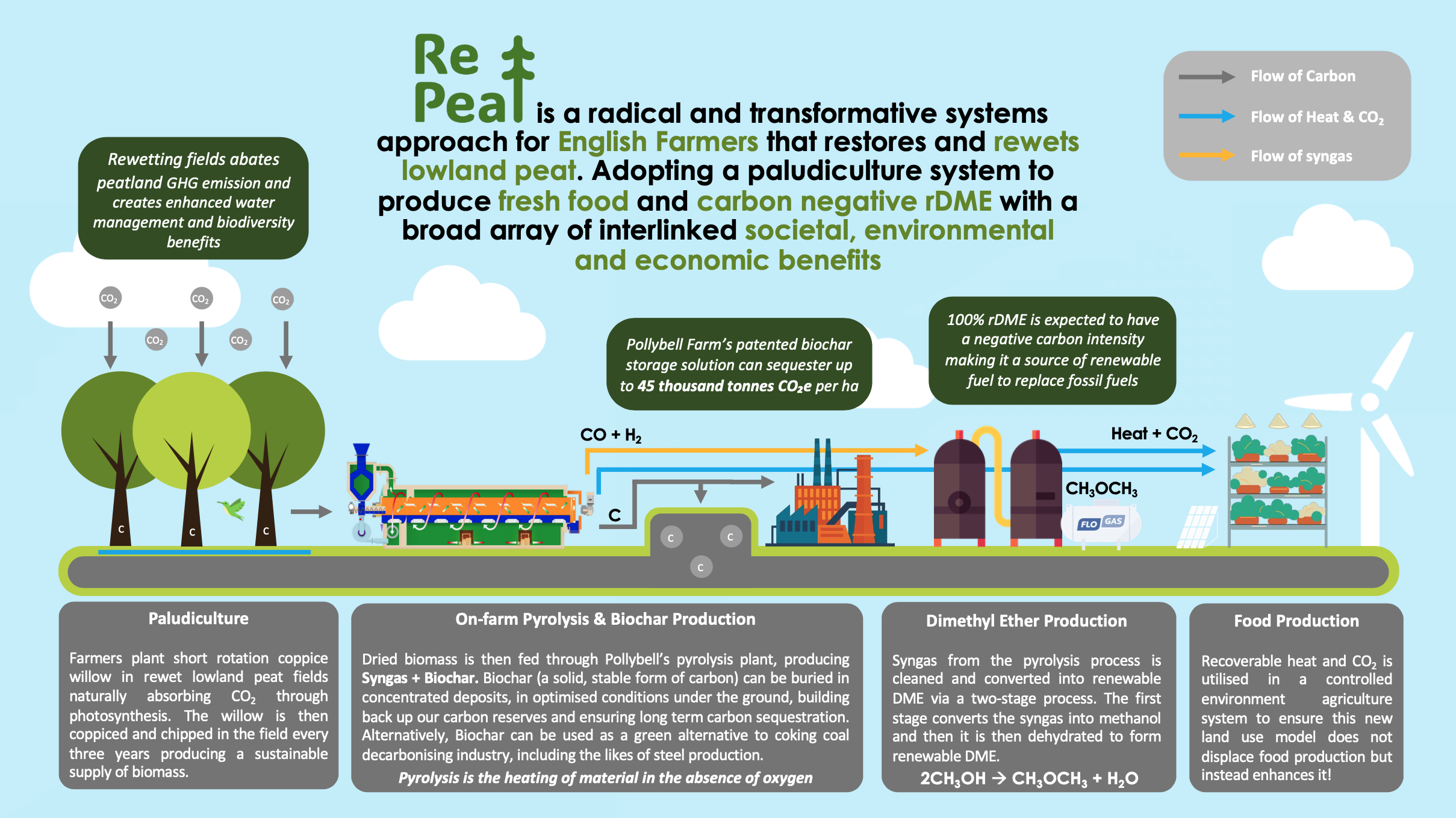
“RePeat brings together farmers and industry, integrating technologies into a single farming system. The innovation lies in how these elements are connected to support sustainable food production, farm resilience and lower-carbon fuels. This project is an exciting opportunity to expand the range of crops and seasons we can offer our customers.”
The project will establish a dedicated production and research facility at Pollybell Farm, creating a testbed for future low-carbon farming models. By capturing and reusing carbon and resources within the system, RePeat improves food and energy systems efficiency and resilience, create skilled rural jobs and strengthen the long-term viability of farms in England.
RePeat builds on more than £9 million of previous research and development undertaken by Pollybell and its partners, including DESNZ and DEFRA funded projects focused on peatland management, climate-resilient food production, on-farm energy systems, and industrial decarbonisation.

Jamie Smith, RePeat Project Manager, Pollybell Farm, said:

“Our ambition is for RePeat to provide a practical, scalable blueprint for farmers to engage with. We see this as true farm diversification, building resilience within agriculture while contributing meaningfully to the UK’s decarbonisation goals”
The findings from RePeat will be shared with farmers, industry and policymakers to support wider adoption of integrated, low-carbon farming systems and inform the future of sustainable food and fuel production in the UK.

About Pollybell Farms, Pollybell is a family owned diverse organic farming business. The Brown family have a strong history in farming for the past 120 years and immense passion for growing healthy, affordable food whilst enhancing the land and surrounding environment. The farm covers 5,000 acres crossing the three county borders of Nottinghamshire, Lincolnshire and South Yorkshire.

About Flogas Britain, Flogas Britain is a national supplier of Liquefied Petroleum Gas (LPG) developing low carbon fuels that can become viable solutions for hard-to-abate properties and high-heat industrial applications. Flogas Britain has published their 2040 vision to support the government’s carbon reduction targets of achieving net zero by 2050.

About the University of Lincoln, UK, Situated in the heart of a historic city, the University of Lincoln transforms lives and communities through teaching, research, and partnerships. In 2023, we received the Queen’s Anniversary Prize — the UK’s highest academic honour – recognising the work of the University’s Lincoln Institute for Agri-food Technology (LIAT).Our strong ties with industry have earned national recognition. More than 75% of our research was rated internationally excellent or world-leading in REF 2021, underscoring our impact. We’re ranked in the global top 300 for progress on the UN Sustainable Development Goals (THE Impact Rankings), including 63rd for reducing inequalities.
LIAT is home to a working farm with specialist research facilities. LIAT’s multi-disciplinary team brings together sector-leading expertise in a diverse range of areas such as; artificial intelligence, robotics, engineering, crop science, environmental sustainability, food manufacturing, product development and supply chain, with goals including supporting and enhancing the future of food and agriculture productivity, efficiency, and sustainability through research, education, and technology.

To find out more about the other projects being delivered through Defra’s Farming Innovation Programme in partnership with Innovate UK, click ‘here’.